
If you run a US digital marketing agency and sell local SEO, the hard question is not whether clients want it. It is how to deliver it without your margins quietly disappearing. When comparing white label local SEO vs in-house team, you have two practical options: build your own local SEO department or partner with a white label local SEO provider that delivers the work under your brand.
Here is the answer most agency owners are looking for, stated plainly. For the large majority of US agencies, white label local SEO is the cheaper and lower-risk choice until you are managing roughly 60 to 70 stable local SEO clients. Below that point, an in-house team means paying substantial fixed costs every month, regardless of how many clients you actually have. A white label partnership turns those fixed costs into variable expenses that scale only as your revenue grows.
The rest of this guide breaks down the numbers behind the white label local SEO vs in-house team decision, with every major figure tied to a US primary source. You’ll also see where the economics begin to shift in favor of building an in-house team, helping you determine which model makes the most financial sense for your agency. All figures are based on the US market and presented in US dollars.
The short answer
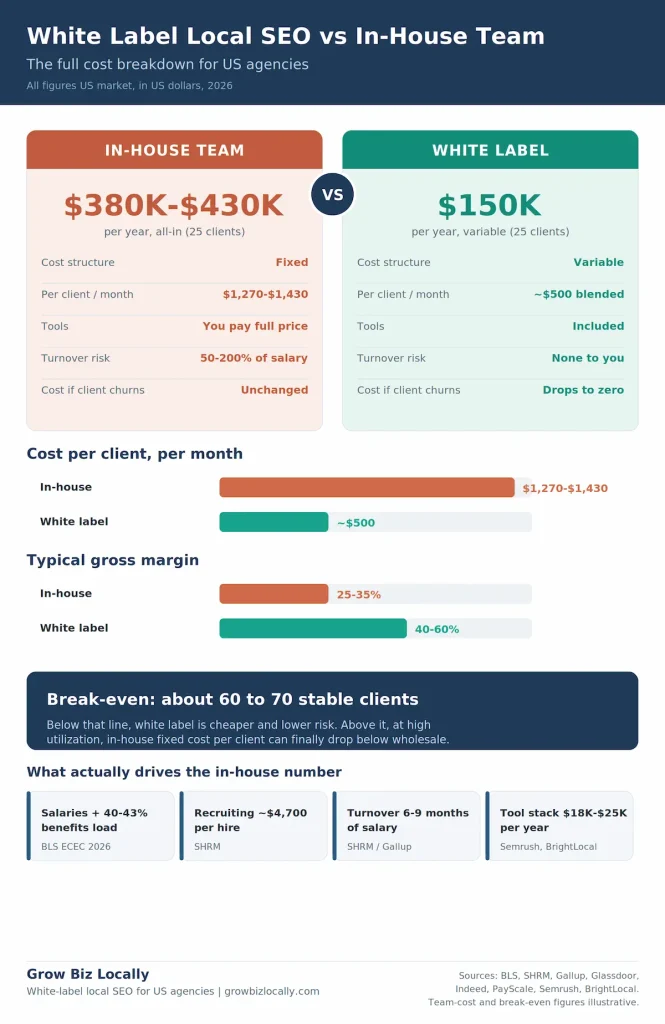
A minimum viable in-house local SEO team costs roughly $380,000 to $430,000 per year once you include benefits, tools, recruiting, and turnover, not just salaries. At 25 clients that works out to about $1,270 to $1,430 per client per month just to break even on delivery.
White label local SEO for the same 25 clients costs roughly $150,000 per year as a pure variable expense, with no salaries, no tools, no recruiting, and no turnover exposure.
Those two numbers are the whole debate. Everything below explains where they come from and when the picture flips.
What each (White Label Local SEO vs In-House Team) model actually means
In-house local SEO
You recruit, hire, train, and manage your own specialists. They work only on your accounts and report to you. You own the tools, the process, and every risk. A functional local SEO operation is rarely one person, because modern local search spans Google Business Profile management, citations and NAP consistency, on-page and technical work, content, reviews, and reporting. Small agencies often start with one generalist and add specialists as they grow.
White label local SEO
You partner with a provider who does the execution while your agency keeps the client relationship and the credit. Your clients see your logo on the reports. You pay a wholesale rate per client and keep the markup. There is nothing to recruit or onboard, and the provider’s tools and team are included in what you pay.
The true cost of an in-house local SEO team
Salaries are only the starting point
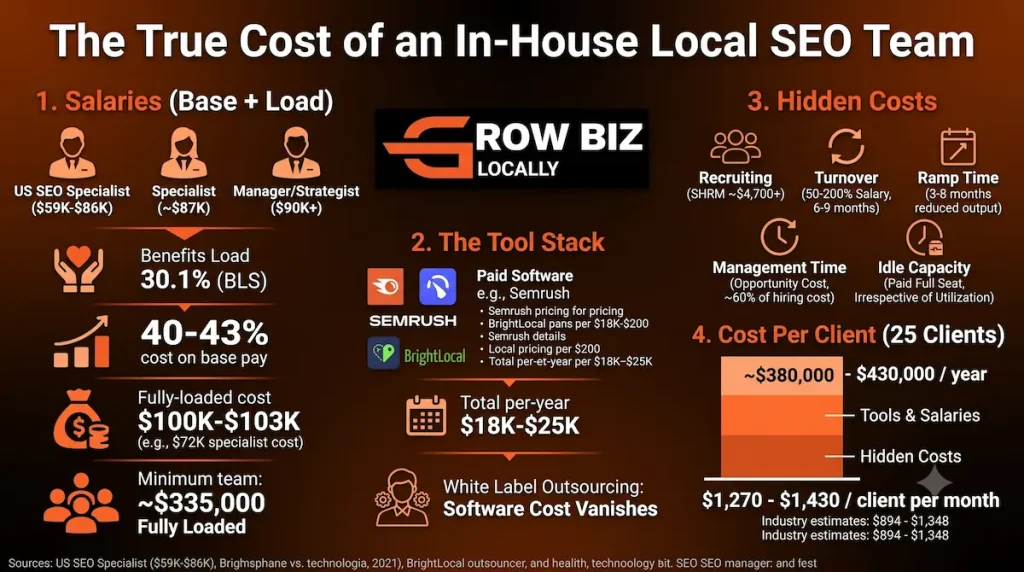
Start with base pay. In 2026, average base salary for a US SEO specialist lands between about $59,000 and $86,000 depending on the source: PayScale reports around $59,000, Indeed around $71,000, and Glassdoor around $86,000. Senior specialists average closer to $87,000, and an SEO manager or strategist typically runs $90,000 or more.
But base salary is where most agency owners stop, and that is the expensive mistake. According to the US Bureau of Labor Statistics, benefits made up 30.1 percent of total compensation for private-industry workers in March 2026, with wages the remaining 69.9 percent. In plain terms, benefits and legally required costs add roughly 40 to 43 percent on top of base wages once you count payroll taxes, health insurance, paid leave, and retirement contributions.
So a specialist you think of as a $72,000 hire actually costs you around $100,000 to $103,000 per year fully loaded. A minimum viable team of one strategist at $95,000 and two specialists at $72,000 each carries about $239,000 in base wages, which becomes roughly $335,000 fully loaded.
The tool stack
Local SEO runs on paid software, and in-house teams pay full price whether they serve five clients or fifty. Using current published US vendor pricing:
● A Semrush Business plan lists at $499.95 per month, about $5,000 to $6,000 per year.
● A local-specific platform such as BrightLocal runs $39 to $59 per month per location on its self-serve tiers, which scales with your client count into the low thousands per year for a growing book.
● Add rank tracking, a content optimization tool, white-label client reporting (AgencyAnalytics or similar), and project management, and a lean but realistic agency stack lands around $18,000 to $25,000 per year.
A white label partner spreads that same tool spend across hundreds of campaigns, which is why the software line vanishes from your books entirely when you outsource.
The hidden costs nobody puts on the P&L
This is where the ranking articles wave their hands and where the real money hides.
Recruiting. SHRM benchmarking data puts the average cost per hire at roughly $4,700 in direct costs alone, with more recent non-executive benchmarks higher. That covers job postings, screening, and onboarding paperwork, not the productivity lost around it.
Turnover. This is the big one. SHRM and Gallup estimate that replacing an employee costs between 50 and 200 percent of their annual salary, with mid-level technical and managerial roles landing in the 100 to 150 percent range. SHRM frames it another way: replacing someone typically costs six to nine months of their salary. SEO specialists are in high demand and tenure is short, so a departure is a question of when, not if. One specialist leaving can cost you $36,000 at the low end and far more once you count lost momentum on their accounts.
Ramp time. A new hire takes 3 to 8 months to reach full productivity, running at reduced output the whole time while you pay full salary.
Management time. Someone senior has to brief, review, coach, and quality-check the team. For a founder, that time carries a real opportunity cost even though it never appears on a payroll line. HR researchers estimate that 60 percent of total hiring cost is this kind of soft cost, with only 30 to 40 percent being hard, visible spend.
Idle capacity. A three-person team covering 25 retainers still gets paid in full during a slow month or after a client churns. You pay for the seat, not the utilization.
Putting it together: cost per client
For a growing US agency serving about 25 local clients:
● Fully loaded salaries: about $335,000
● Tools: about $22,000
● Recruiting and turnover reserve: about $25,000 to $40,000
● Management overhead: real but often uncounted
That is roughly $380,000 to $430,000 per year, or about $1,270 to $1,430 per client per month before you have earned a cent of margin. Industry estimates that put in-house delivery at $894 to $1,348 per client per month sit right inside that range, which is a good sign the model holds up.
The cost of white label local SEO
What you pay
White label wholesale pricing is tiered by scope. Typical US ranges reported across the market:
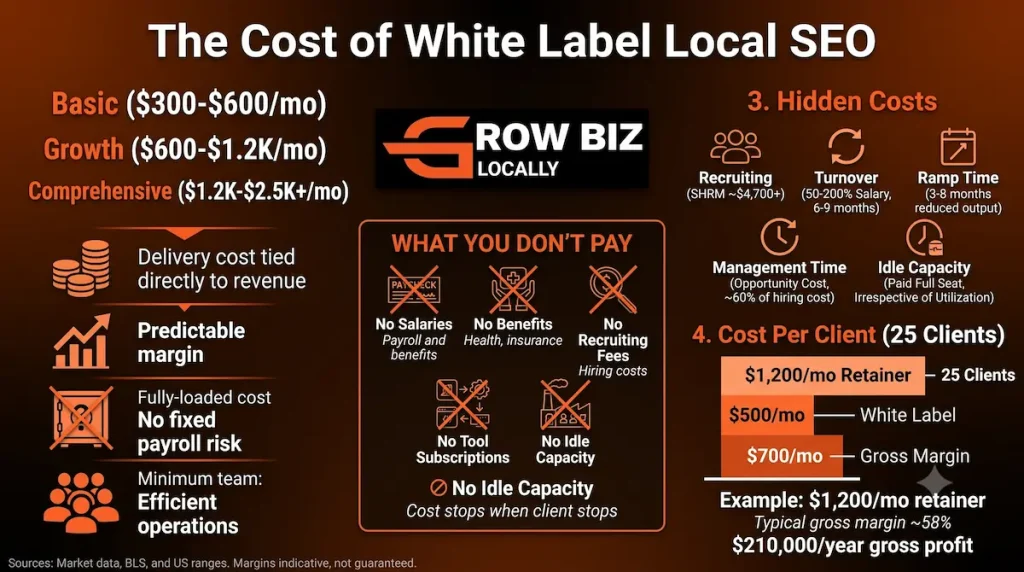
● Basic (GBP management, citations, rank tracking, monthly reporting): $300 to $600 per client per month
● Growth (adds content and more competitive optimization): $600 to $1,200
● Comprehensive or multi-location: $1,200 to $2,500-plus
At a blended $500 per client, 25 clients cost $12,500 per month, or $150,000 per year.
What you don’t pay for
No salaries. No benefits. No recruiting fee. No turnover exposure. No tool subscriptions. No idle capacity when a client churns, because the cost stops the moment the client does. Your delivery cost is tied directly to your revenue, which makes your margin predictable in a way payroll never is.
Worked example: the same 25 clients
Charge each client $1,200 per month, a normal US local SEO retainer. Your white label cost is $500. That is a $700 gross margin per client, or roughly 58 percent. Across 25 clients that is $210,000 in gross profit per year, with essentially no fixed overhead at risk.
Run the same 25 clients in-house at a delivery cost near $1,350 per client, and you are underwater on delivery until utilization is very high, because the fixed team cost does not shrink when a client leaves.
Side-by-side comparison
| Factor | In-house team | White label |
| Cost structure | Fixed | Variable, scales with clients |
| Annual cost (25 clients) | ~$380K to $430K | ~$150K |
| Cost per client / month | ~$1,270 to $1,430 | ~$500 blended |
| Tools | You pay full price | Included |
| Recruiting and turnover | Your risk (50 to 200% per exit) | Provider’s problem |
| Ramp-up on new capacity | 3 to 8 months | Days |
| Cost when a client churns | Unchanged | Drops immediately |
| Typical gross margin | 25 to 35% | 40 to 60% |
| Control and knowledge | High | Lower |
Profit margins compared
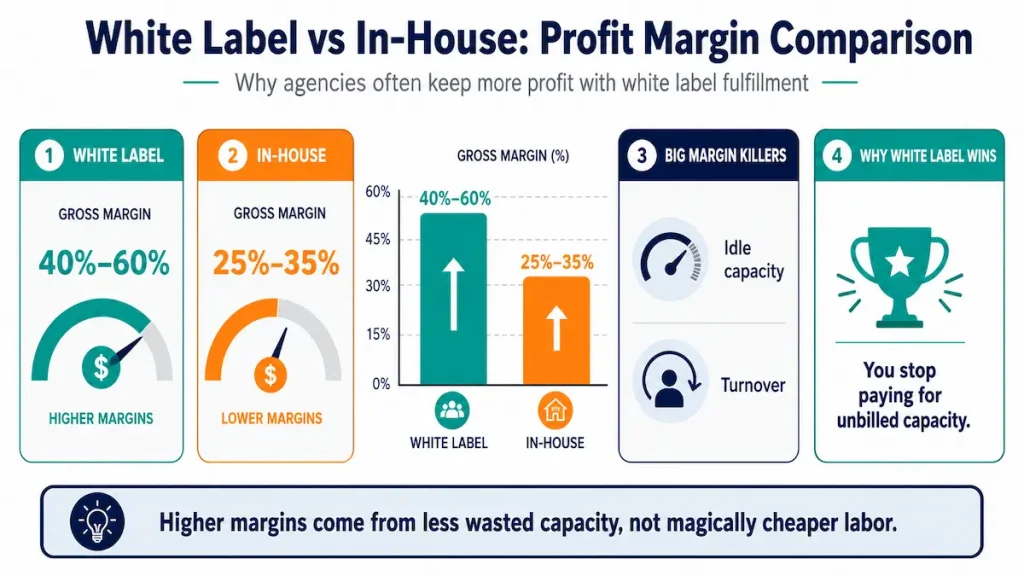
Agencies consistently report higher margins on white label because the two biggest margin killers, idle capacity and turnover, are removed. Reported gross margins of 40 to 60 percent on white label versus 25 to 35 percent in-house are common across the US market. The gap is not because outsourced labor is magically cheaper per hour. It is because you stop paying for capacity you are not billing.
If you want to see this for your own book, plug your client count, average retainer, and wholesale cost into a simple profit calculator before you commit either way.
When in-house actually wins
An honest guide has to say this clearly, because it is true and most pages selling white label skip it.
In-house beats outsourcing when several of these hold at once:
● High, stable volume. Once you sustain roughly 60 to 70 or more local clients, your fixed team cost per client can fall below wholesale pricing. Each capacity tier still requires a step-change hire, so the crossover is real but not free.
● Deep single-market or single-vertical focus. A specialist embedded in one US metro or industry accumulates competitive and regulatory knowledge that a generalist provider will not match.
● You want to build a sellable asset. If SEO is becoming a core, brand-defining capability rather than a bolt-on, owning the expertise matters.
● Real-time agility needs. When a client’s Google Business Profile gets suspended, an in-house team with spare capacity can respond in hours. That said, a small in-house team without backup is a single point of failure, which cuts the other way.
If most of your clients are one-off local businesses across scattered markets and your volume swings month to month, in-house rarely pencils out.
The hybrid model most growing agencies land on
The common endpoint is not purely one or the other. Many US agencies keep one in-house strategist or account lead who owns client relationships, briefs, and quality control, and hand execution (technical work, content, citations, link building, local optimization) to a white label partner. You get relationship accountability and brief quality from your own person, plus specialist execution depth and variable cost from the partner. It usually beats either pure model at the growth stage.
How AI search changes the math
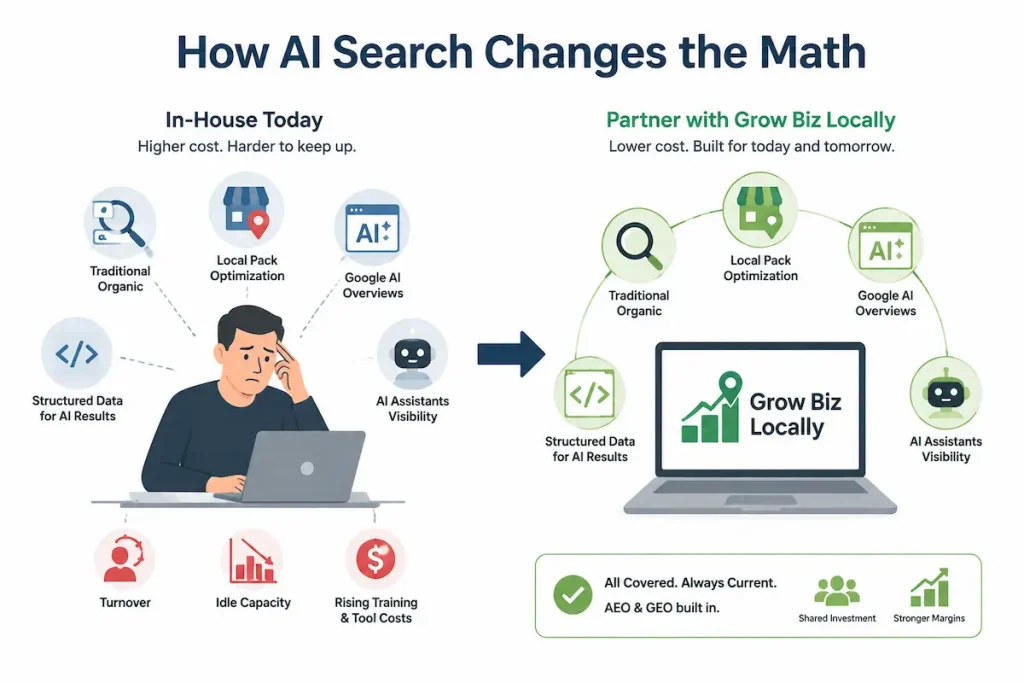
The build-versus-buy calculation looked different two years ago. In 2026, competing in US local search increasingly means covering traditional organic, local pack optimization, Google AI Overviews, structured data for generative results, and visibility inside AI assistants. Answer Engine Optimization (AEO) and Generative Engine Optimization (GEO) are becoming distinct disciplines, not a footnote.
For an in-house team, that is a rising training and tooling burden across several fast-moving fields at once, exactly the kind of continuous investment most agencies struggle to justify for a small team. It raises the effective cost of staying current in-house and strengthens the case for a partner who already spreads that investment across many clients. Grow Biz Locally treats AEO and GEO as a built-in service layer alongside traditional local SEO, so agency partners can offer it without funding the learning curve themselves.
A decision framework by agency stage
● Solo operator or new agency (under 10 local clients): White label, every time. You cannot justify a single fully loaded hire, and flexibility matters most.
● Growing agency (10 to 50 clients): White label or hybrid. Keep a strategist in-house if you want tighter client control, outsource execution.
● Established agency (50-plus stable clients in a focused niche or metro): Start modeling in-house or a larger hybrid team, but only if utilization will stay high.
● Any agency with swingy volume or scattered markets: Stay variable. Fixed payroll against unpredictable revenue is the fastest way to erode margin.
You can start with white label to keep costs low while you build the book, then transition selectively as the numbers justify it. A good partner supports that move rather than resisting it.
Frequently Asked Questions
Will my clients know I use a white label provider?
No. White label delivery is designed to be invisible. Reports carry your branding and communication flows through your team.
Can I switch from white label to in-house later?
Yes, and many agencies do. The natural transition point is when your local SEO revenue reliably covers a fully loaded team with margin to spare.
Is white label lower quality than in-house?
Not inherently. A single in-house generalist rarely matches the combined depth of a provider’s technical, content, and local specialists. Quality depends on the partner, which is why vetting matters.
What is the real break-even between the two?
Roughly 60 to 70 stable local clients, held at high utilization, is where in-house fixed cost per client can drop below wholesale pricing. Below that, white label almost always wins on cost.
How do I protect my margin either way?
Price to your value, not your cost, and model your delivery cost per client honestly before you sign clients or make hires.
Ready to run the numbers for your agency?
If you are weighing build versus buy, the fastest way to decide is to see your own margin on paper. Grow Biz Locally delivers fully white-labeled local SEO for US agencies, including AEO and GEO, with transparent per-client pricing and no fixed overhead on your side.
Request a quote and we will map your current client book to a delivery cost and projected margin, so you can compare it against the true cost of hiring before you commit.